
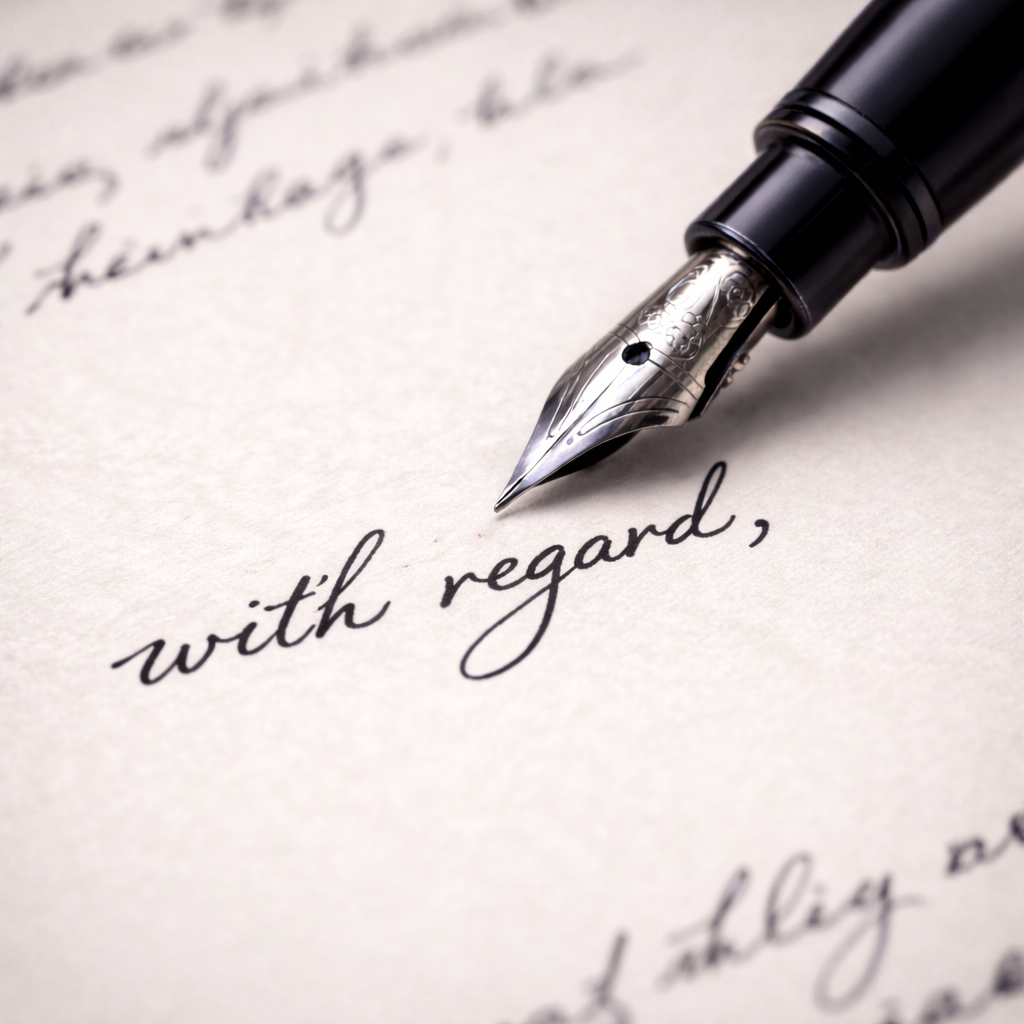
Within the Tudors Estate, correspondence is concluded in a particular way. Not “kind regards”. Not “with regards”. Simply “With regard“.
To most recipients, this passes unnoticed. It reads as formal, restrained and entirely unremarkable. Yet, as with many of Tudors Estate conventions, the distinction is deliberate. The difference is subtle, but it matters.
A Phrase That Hides in Plain Sight
At first glance, “with regard” appears interchangeable with “with regards”. Modern usage has trained the reader to see the two as equivalent. As a result, the singular form rarely draws attention. It blends into the expected visual rhythm of professional correspondence.
That is precisely the point.
Those unfamiliar with the distinction read past it. Those who understand language, form and history recognise that the choice is intentional.
The Difference
The two phrases originate from different meanings of the same word.
“With regards”
- Uses regards as a plural count noun
- Means expressions of goodwill or sentiments
- Closely related to:
- Kind regards
- Best regards
- Warm regards
- Emotional, modern, and social in tone
“With regard”
- Uses regard as a singular abstract noun
- Means consideration, attention, or reference
- Derived from the formal construction:
- with regard to (meaning concerning)
Although contemporary English often merges the two, they are not the same. One offers sentiment; the other offers consideration.
The Tudors Estate uses the latter.
Why “With Regard” Is Grammatically Correct
In formal English, regard has long functioned as an abstract noun. Examples include:
- With regard to the matter at hand…
- With regard to your earlier correspondence…
When used as a closing, “with regard” is an elliptical construction. The object is implied, not missing. The consideration is the correspondence itself.
This is no different from other accepted sign-offs:
- Yours sincerely (sincerely what?)
- Respectfully (respectfully submitted)
- Faithfully
Nothing is incomplete. The grammar is intact.
The Stylistically Archaic Character
The phrase feels slightly archaic because it preserves older linguistic discipline. Before email conventions softened professional language, closings were procedural rather than expressive. Letters were concluded with statements of form, not warmth.
“With regard” belongs to that earlier tradition. It reflects:
- Restraint rather than familiarity
- Continuity rather than novelty
- Precision rather than embellishment
It is not obsolete. It is simply unmodernised. That unmodernised quality is what gives the phrase its quiet authority.
Why the Distinction Matters
Most people will not notice the difference. They are not meant to.
But to those with editorial sensitivity, legal training, or an ear for historical English, the singular form registers immediately. It signals:
- Deliberate choice
- Institutional voice
- Adherence to form over fashion
A House Convention
The Tudors Estate does not use with regards.
Not out of pedantry. Not out of affectation, because language, like ink, carries meaning beyond what is immediately seen. The smallest distinctions often endure the longest.
With regard,
Tudors Estate